Guides and research
We test popular game tips by playing thousands of games with our own engines, and we read the research behind brain tests so you do not have to.
 How to play FreeCell: rules, supermoves and winning strategyHow to play FreeCell step by step: 8 columns, 4 free cells and 4 foundations, how many cards you can move at once, and the FreeCell strategy that wins deals.
 How to play mahjong solitaire: rules, tiles and strategyHow to play mahjong solitaire: match pairs of free tiles, what makes a tile free, which tiles match (flowers and seasons too) and how to clear the board.
 How to play reversi: rules, strategy and how to winHow to play reversi: the setup, how flipping works, passing and scoring, plus the strategy that wins: corners, X-squares and C-squares, mobility and parity.
 How to play minesweeper: rules, patterns and how to winHow to play minesweeper: what the numbers mean, the safe first click, chording, the 1-2-1 and 1-2-2-1 patterns, and how to guess well when you have to.
 How to play solitaire: Klondike rules, setup and winning tipsHow to play solitaire step by step: the Klondike setup with 28 cards in 7 columns, the solitaire rules for moving cards, Draw 1 vs Draw 3, scoring and tips.
 Killer sudoku combinations: every cage table, plus the 45 ruleKiller sudoku combinations for every 2- and 3-cell cage, the unique sums to learn first, the rule of 45 with innies and outies, and how to play killer sudoku.
 Spider solitaire rules: how to play with 1, 2 or 4 suitsSpider solitaire rules made simple: the 104-card setup, how cards move, dealing from the stock, removing King-to-Ace runs, 1, 2 or 4 suits, and strategy.
 How to teach a child addition: one method, step by stepHow to teach a child addition without confusion: one research-based method, from counting objects to ten frames, counting on, doubles and make ten, with games.
 Math games by age: what to practise from 3 to 8Which math skills to practise at each age from 3 to 8, from counting and ten frames to adding and subtracting within 20, with free games for each age.
 Math games for kids with ADHD: what actually helpsWhat makes a math game ADHD-friendly: short levels, one step on screen, instant feedback, visual models and no timers. What research says and what it can't.
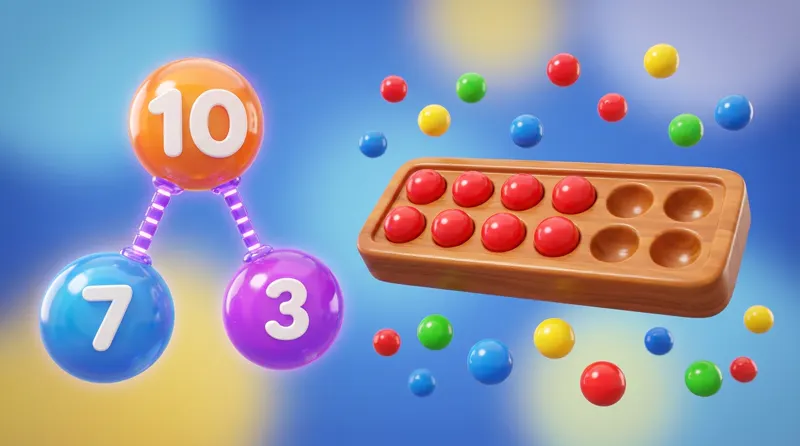 Number bonds and ten frames: a parent's guideWhat number bonds and ten frames are, why schools use them, and how to practise them at home with simple games. Clear examples for kindergarten and first grade.
 25 games to play with friends, online and in personThe best games to play with friends: party games on one phone, two-player classics, word games and online games you can start in seconds, all free, no sign-up.
 Hard hangman words: 100 tricky words and why they workThe best hard hangman words, and why they are hard: short words with rare letters, few vowels and repeated letters. 100 tricky picks plus easy words for kids.
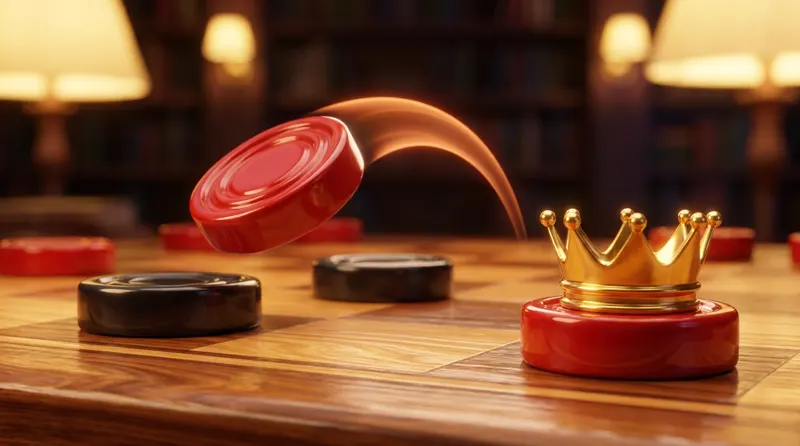 How to play checkers: the complete beginner's guideHow to play checkers, step by step: the board, how pieces move and capture, kings, forced jumps and how to win. Plus 8 strategy tips beginners can use today.
 How to play Mancala: rules and winning strategyLearn how to play Mancala (Kalah rules): setup, sowing seeds, extra turns, captures and how the game ends. With simple strategy tips to win more often.
 How to solve sudoku: seven strategies, from easy to expertHow to solve sudoku step by step: scanning, pencil marks, naked and hidden singles, pairs, pointing pairs and X-wing, with an example and the order to use them.
 20 icebreaker games that actually break the iceQuick icebreaker games for any group: no-prep ideas for classrooms, work teams, parties and video calls, plus phone games that break the ice in one minute.
 Imposter game words: 200 ideas for your next partyThe best imposter game words, sorted into categories: food, animals, places, jobs, everyday objects and football. Easy, medium and hard picks for any group.
 Does dual n-back increase IQ? What the studies actually foundDoes dual n-back training really raise IQ? We read the key studies and meta-analyses since 2008: what it improves, what it doesn't, and how to train well.
 Does the 2048 corner strategy work? We played 10,000 games to find outGuides say the 2048 corner strategy wins almost every time. We tested it in 10,000 games: as a simple rule it never reached 1024. Here is what actually works.
 Is every water sort puzzle solvable? We tested 25,200 boardsWe dealt 25,200 random water sort boards and solved each one by computer. With two empty tubes every board was solvable; with one, almost none were.
 Schulte table: how to use it, and what it can really doWhat is a Schulte table, how do you train with it, and what can it really do for your focus and reading speed? An honest guide with the research behind it.
 What is a good reaction time? Averages, age and how to get fasterWhat is a good reaction time? Lab studies put the average near 230 ms. See what your online score means, how age and your device change it, and how to improve.
 What is a good typing speed? Average WPM, benchmarks and how to get fasterWhat is a good typing speed? A study of 168,000 people found an average of 52 WPM on a keyboard and 36 on phones. See where you stand and how to type faster.
How we research our guides
Most game guides repeat the same advice without checking it. When a claim can be tested, we test it: our 2048 article is based on 10,000 simulated games, and our water sort study solved 25,200 random boards. We keep the code for every study and use fixed random seeds, so the results can be repeated.
For brain tests we go to the source. Articles about reaction time, typing speed and brain training are based on published studies, which we link at the end of each article, and we say clearly when the evidence is weak. Every article also links to the games it is about, so you can try the ideas straight away.