What is Slitherlink?
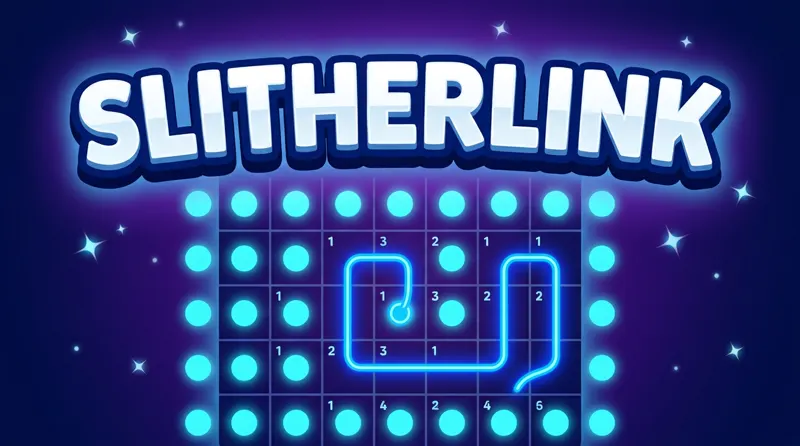
Slitherlink is a loop-drawing logic puzzle. You connect the dots of a grid to form one continuous loop, guided by the numbers inside the squares. Each number counts how many of that square’s four sides the loop uses.
It starts simple and quickly becomes one of the most absorbing puzzles in the Nikoli family. Play Slitherlink online free here.
Where Slitherlink comes from
Slitherlink is one of the classic Nikoli puzzles from Japan, also known as Loop the Loop. The grid is a field of dots with numbers between them, and you draw a single closed loop along the dotted lines. Each number says how many of the four sides around it are part of the loop.
How to play here
With a mouse, left-click an edge to draw a line and right-click to mark it with a cross, meaning the loop does not use it. On a phone, tap to draw lines and switch on Mark mode (the flag button next to Undo) to place crosses. Crosses are essential in Slitherlink: most deductions come from ruling edges out.
A step-by-step way to solve
- Cross out around every 0. None of its four sides are used.
- Look at 3s next to each other. Two 3s side by side always share their middle line and both outer lines.
- Use the corners. A 3 in a corner uses both of its outer edges; a 1 in a corner uses neither.
- Apply the dot rule. Every dot has either zero or two loop lines. If a dot already has two lines, cross out the rest; if it has one line and one possible way out, draw it.
- Avoid small loops. The answer is a single loop. Never close a small loop while other lines are still unfinished.
Why play Slitherlink?
Slitherlink is often called one of the most satisfying logic puzzles, because simple local rules add up to a single, elegant loop. The first few boards take patience; after that the patterns become second nature. Try Masyu next for another loop puzzle.
How to play Slitherlink
- Connect the dots with lines to make one single closed loop.
- The loop may not cross itself or branch.
- A number in a square shows how many of its four sides are part of the loop.
- Squares without a number can have any number of sides used.
Slitherlink tips
Start with 0s and 3s
A 0 means none of its sides are used, so cross them all out. A 3 next to a 0 fixes three lines almost at once.
Two 3s side by side
When two 3s touch, the edge between them and both outer edges are always part of the loop.
Every dot has 0 or 2 lines
A loop passes through a dot or skips it. If a dot already has two lines, cross out its others; if it has one, the loop must continue.
Frequently asked questions
What is loop the loop?
Loop the loop is another English name for Slitherlink. Both names describe the same one-loop puzzle.
Can there be more than one loop?
No. The solution is always one single closed loop.
Who created Slitherlink?
Slitherlink was first published by Nikoli in Japan in 1989.