The number snake, unlimited
A chain of numbers runs from 1 to the last number and fills every open square. Each link touches the next one, and touching includes the corners. Some links are shown. You fill in the rest so the chain is complete.
This puzzle was made popular as Hidato by the Israeli mathematician Gyora Benedek. Here it comes on 5×5, 7×7 and 8×8 boards, the bigger ones with holes that give each board its own shape. Every puzzle has exactly one solution, there is a daily board for everyone, and your progress is saved on this device.
How diagonal moves change things
With diagonals allowed, a square in the middle of the board has eight neighbours instead of four. That gives the chain far more freedom, so a single given number rarely tells you much on its own. The puzzle is solved by the spaces between numbers: how far apart two givens are, and how many squares the chain has to use up on the way.
Diagonal moves also mean the chain can slip between two squares that only meet at a corner. Keep that in mind near holes, where a diagonal step is often the only way through.
Strategy: bottlenecks and counting gaps
Count the steps. The fewest moves between two squares is the bigger of the two distances: rows apart or columns apart. Compare that with the difference between the numbers. If 30 and 35 are five steps apart, the chain between them has no slack and must head straight from one to the other. If they are only two steps apart, the chain has three spare moves to spend, and you need to find where it wanders.
Find the bottlenecks. Holes and edges create narrow places. A square with only two free neighbours must be entered through one and left through the other. A corridor one square wide forces the chain to run along it in order. These are the first places to look on the shaped boards.
Work from the ends of a gap. For a missing number, list the free squares next to the number before it, then cross out any that are too far from the next given number. When only one square survives, place it. The dots on the board do this check for you: select a number and they show where the next one can go.
Close short gaps, then long ones. A gap of one or two numbers is usually forced. Each one you fill shortens the gaps around it, and the board opens up from there.
Check for stranded squares. An empty square that no open gap can reach in time is a sign of a wrong turn. Undo back to your last sure step.
Playing here
Drag from any number into empty squares to lay the next numbers, or drag back to take them off. You can also tap a square and type on the pad or keyboard. A wrong number shakes and is not placed, and the mistake counter goes up. Undo, Erase and Hint are at the bottom; Restart, New game and Show solution are in the pause menu. When you finish, the whole snake lights up from 1 to the end.
Why play
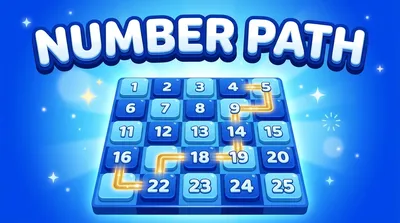
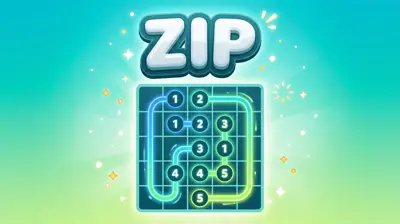
Number snakes take a few minutes and need no maths beyond counting, which makes them a calm daily habit. If you prefer the stricter up-down-left-right version with its odd and even colour trick, play the Number Path puzzle. For a quick line-drawing puzzle, try Zip.
How to play Number Snake
- Fill every open square with a number so the board holds each number from 1 to the last one exactly once.
- Each number must touch the number before it and the number after it. Touching includes the four diagonal corners, so a square has up to eight neighbours.
- Dark holes are not part of the board. The chain goes around them.
- The first and last numbers are always shown, along with some in between.
- Every puzzle has exactly one solution. A number that does not match it is refused and counts as a mistake.
Number Snake tips
Find the bottlenecks
A square boxed in by holes, edges and given numbers may have only one or two free neighbours left. The chain must pass through it in a fixed way, so fill those squares first.
Count the gap between two numbers
With diagonal moves, the fewest steps between two squares is the larger of the row distance and the column distance. If 18 and 23 are five steps apart, the numbers in between must march straight across with no wasted moves.
Look for a number with one possible square
Take a given number whose next number is missing. Check its free neighbours and cross out any that are too far from the next given number. Often only one square is left.
Don't leave stranded squares
Every empty square must end up between two numbers whose gap is big enough to reach it. A square far from every open gap means an earlier guess was wrong.
Frequently asked questions
How do you solve a numbrix puzzle?
Numbrix is the orthogonal cousin of this puzzle: the path moves only up, down, left or right. Fill the short gaps between close numbers first, count moves between further pairs, and use the checkerboard rule that odd and even numbers sit on opposite colours. Our Numbrix-style version is the Number Path puzzle.
What is the difference between numbrix and hidato?
Both chains link consecutive numbers that touch. Hidato lets the chain move diagonally, so each square has up to eight neighbours, the board can have holes, and the first and last numbers are always given. Numbrix allows only up, down, left and right on a full square grid, which brings in the odd and even colour trick. Diagonal moves make Hidato chains more flexible, so the logic leans on counting gaps and finding bottlenecks instead.
How do I enter numbers?
Press on a number and drag into empty squares to lay the next numbers in order. Or tap an empty square and type the number on the pad or keyboard; it goes in as soon as no longer number is possible, or when you press the check key.
Why is it called a number snake?
Because the finished chain winds across the board like a snake, from 1 at its tail to the last number at its head. Puzzles like this also appear as number snake, number chain or Hidoku.
Is there a daily puzzle?
Yes. Choose Daily on the start card for the board of the day, the same for everyone, changing at midnight UTC. Easy, Medium and Hard give you unlimited boards.
Is Hidato a trademark?
Yes. Hidato is a registered trademark of Doo-Bee Toys & Games Ltd., the company of its inventor, Gyora Benedek. This puzzle uses the same rules under a generic name, and MindedGames is not affiliated with Doo-Bee.