Train your memory for order
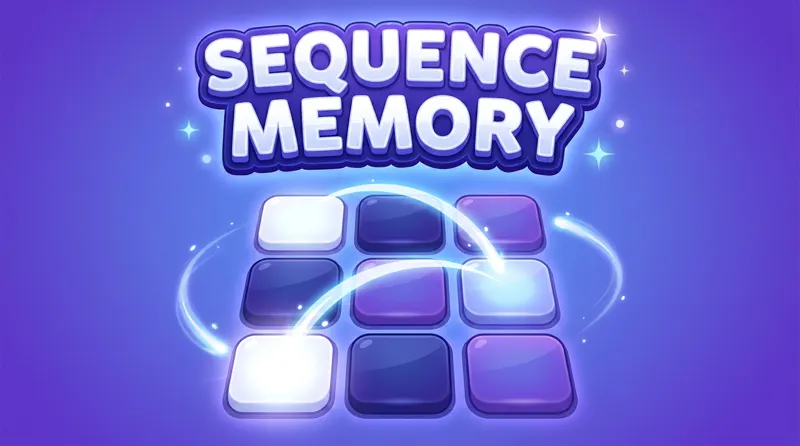
This sequence memory test asks you to remember not just which tiles lit up, but in which order. The pattern grows by one step every level, so each round is a little harder than the last.
Where this test comes from
This game is a digital version of a classic psychology task called the Corsi block-tapping test, introduced by Philip Corsi in the early 1970s. In the original, an examiner tapped a sequence of wooden blocks on a board and the person being tested had to tap the same blocks in the same order. The longest sequence someone can repeat is called their spatial span, and for most adults it sits around five to seven blocks.
Our version lights up the tiles on a 3×3 grid instead of tapping blocks, and the sequence keeps growing by one step each level, so you are always working at the edge of what you can hold.
How to play
Watch the tiles light up one after another, then tap them in the same order. If you get it right, the same sequence plays again with one new step added at the end. One wrong tap ends the game, and your level is your score.
Techniques that help
- Turn positions into numbers. Number the tiles 1 to 9 like a phone keypad. A sequence becomes “3, 7, 2, 2”, which you can repeat silently.
- Only learn the new step. The start of the sequence never changes, so you are adding one item each round, not learning a new list.
- See the shape. Many sequences trace a line, a triangle or a zigzag. A shape is much easier to recall than separate flashes.
- Watch the whole grid. Keep your eyes near the center so you catch every flash, including ones in the corners.
Why order is harder than position
Remembering where something was is one skill; remembering the order things happened in is another, and it is usually harder. That is why your score here is often lower than on the visual memory test. Both improve with practice, but mostly at the specific task you practice, so mixing several memory games keeps things interesting.
Try these memory tests next
The visual memory test uses a similar grid but asks you to remember a whole pattern at once instead of an order. The chimp test mixes positions and numbers, and memory match is a calm, classic pairs game for a break between harder rounds.
How to play Sequence Memory Test
- Tiles on a 3×3 grid light up one after another.
- When they stop, click the same tiles in the same order.
- Each level replays the whole sequence and adds one new step.
- One wrong tile ends the game. Your score is the longest sequence you repeated.
Sequence Memory Test tips
Name the tiles
Number the tiles 1 to 9 like a phone keypad and repeat the sequence as numbers in your head.
Only learn the new step
The sequence never changes, it only grows. Keep what you had and add the last tile.
Picture a shape
Many sequences draw a line or a zigzag. Seeing the shape is easier than remembering single flashes.
Frequently asked questions
What is a good sequence memory score?
Most people reach level 8 to 10. Beyond 12 is excellent.
Is this like the old Simon game?
The idea is similar, a growing sequence to repeat, but here all nine tiles look the same, so you rely on position alone.
Is this a medical test?
No. It is a memory game for fun and practice.