Does dual n-back increase IQ? What the studies actually found

The short answer
Dual n-back makes you very good at dual n-back. It also helps a little with tasks that look like it, such as other working-memory tests. But when researchers compare trainees with a group that does a different, equally engaging activity, the IQ gains mostly disappear. After nearly two decades of studies, the careful answer is: it probably does not raise your IQ in any lasting, general way.
That does not make it useless. It is one of the most demanding concentration exercises you can do in a few minutes, and it is a good way to see your working memory at its limit. You can try dual n-back here and judge for yourself.
What dual n-back is
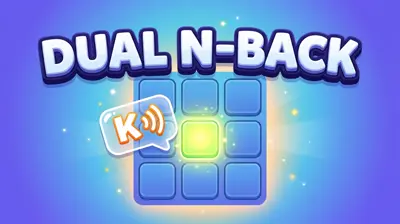
Every couple of seconds a square lights up somewhere on a 3×3 grid, and at the same time you hear a letter. Your job is to say whether the square is in the same place as it was n turns ago, and whether the letter is the same as n turns ago. At 2-back you compare with two turns back; at 3-back, three; and so on. Two streams at once (position and sound) is what makes it “dual”.
It is hard because you have to keep updating a short list in your head while new items arrive, which is exactly what psychologists call working memory.
Where the IQ claim came from
In 2008 Susanne Jaeggi and colleagues published a study in PNAS in which young adults who trained on dual n-back for a few weeks improved on a test of fluid intelligence, the kind of reasoning measured by matrix puzzles. The more they trained, the more they improved. It was widely reported, and “brain training that raises IQ” apps followed.
That study had a small sample and compared trainees with a control group that did no training at all. Both points became central to what happened next.
What happened when others tested it
| Study | What it was | What it found |
|---|---|---|
| Jaeggi et al., 2008 (PNAS) | Original training study | Gains in fluid intelligence after dual n-back training |
| Redick et al., 2013 (J. Exp. Psychology: General) | Randomized study with a placebo-style control task | No evidence of intelligence improvement |
| Au et al., 2015 (Psychonomic Bulletin & Review) | Meta-analysis of 20 n-back studies | A small positive effect on fluid intelligence (g = 0.24) |
| Dougherty et al., 2016 (Psychonomic Bulletin & Review) | Re-analysis of the same 20 studies | Studies with a do-nothing control favored an effect; studies with an active control leaned toward no effect |
| Melby-Lervåg, Redick & Hulme, 2016 (Perspectives on Psychological Science) | Meta-analysis: 87 publications, 145 comparisons | Better at working-memory tasks right after training; no convincing far transfer to intelligence, reading or arithmetic against a treated control |
| Soveri et al., 2017 (Psychonomic Bulletin & Review) | Meta-analysis of 33 randomized n-back trials | Medium gains on other n-back tasks, small gains on other working-memory and reasoning tasks: mostly task-specific |
Two patterns stand out.
Gains shrink as the comparison gets fairer. If the control group simply waits, trainees look better afterwards, but they also spent weeks doing something effortful and expected to improve. When the control group does another engaging task, the difference largely vanishes. That points to expectation and motivation, not a smarter brain.
Transfer is near, not far. Training reliably improves the trained task and things that closely resemble it. “Far transfer” to general intelligence, school subjects or everyday memory is where the evidence runs out.
So what is dual n-back good for?
- A hard focus workout. Few tasks demand this much sustained attention in five minutes. Many people use it as a warm-up before study or work, and that is a reasonable use even if it does not change IQ.
- Seeing your progress. Your n-back level is a clear number that goes up with practice. It is satisfying, as long as you remember it measures skill at this task.
- A fair test of working memory. Where you plateau says something real about how much you can juggle at once today, which can change with sleep, stress and time of day.
How to train if you want to
- Start at 2-back and only move up when you get most rounds right. Our dual n-back game lets you pick the level.
- Keep sessions short: around 15 to 20 minutes. Accuracy drops quickly when you are tired, and tired practice teaches little.
- Do not guess. Only press when you are sure. Random presses make the score noisy and the practice pointless.
- Mix in other tests that stretch different parts of memory, such as sequence memory, number memory and visual memory. Variety keeps practice interesting, which matters more than any one task.
If your real goal is a sharper mind
The research on brain-training games in general tells the same story as dual n-back: you get better at what you practice. So practice the things you actually want to be good at, whether that is a language, an instrument, chess or your job, and treat puzzles and brain tests as what they are: good fun and a good challenge. Sleep, regular exercise and time with other people are the everyday habits most often linked to healthy thinking as we age.
Sources
- Jaeggi, S. M., Buschkuehl, M., Jonides, J., & Perrig, W. J. (2008). Improving fluid intelligence with training on working memory. PNAS, 105(19), 6829–6833.
- Redick, T. S., et al. (2013). No evidence of intelligence improvement after working memory training: a randomized, placebo-controlled study. Journal of Experimental Psychology: General, 142(2), 359–379.
- Au, J., Sheehan, E., Tsai, N., Duncan, G. J., Buschkuehl, M., & Jaeggi, S. M. (2015). Improving fluid intelligence with training on working memory: a meta-analysis. Psychonomic Bulletin & Review, 22(2), 366–377.
- Dougherty, M. R., Hamovitz, T., & Tidwell, J. W. (2016). Reevaluating the effectiveness of n-back training on transfer through the Bayesian lens: support for the null. Psychonomic Bulletin & Review, 23, 306–316.
- Melby-Lervåg, M., Redick, T. S., & Hulme, C. (2016). Working memory training does not improve performance on measures of intelligence or other measures of “far transfer”. Perspectives on Psychological Science, 11(4), 512–534.
- Soveri, A., Antfolk, J., Karlsson, L., Salo, B., & Laine, M. (2017). Working memory training revisited: a multi-level meta-analysis of n-back training studies. Psychonomic Bulletin & Review, 24, 1077–1096.