The classic pairs game
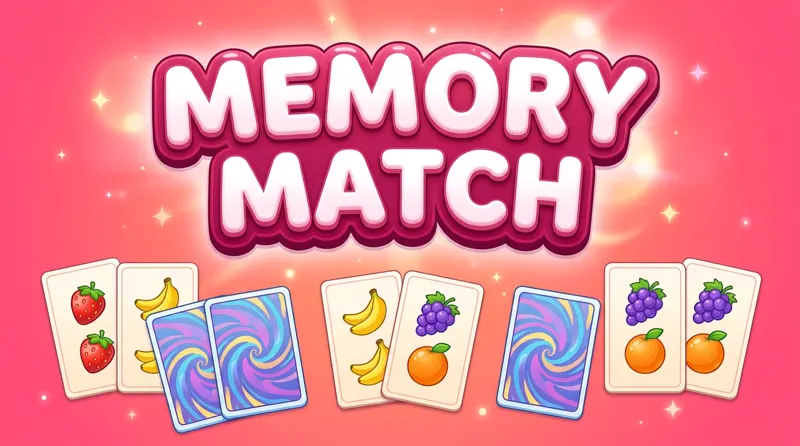
Memory match is the card memory game many of us played as children, now with eight clear symbols and a move counter. It is a gentle way to warm up your short-term memory, and a game takes about a minute.
How to play memory match well
Each turn you flip two cards. If they show the same symbol, they stay open and count as a pair; if not, they turn back over and you try again. The game ends when all eight pairs are found, and your score is the number of turns it took. Fewer is better.
The secret is that a good memory player never flips randomly. A simple system does most of the work for you:
- Open new cards in a fixed order. Work along the rows from the top left. You will always know which cards you have not seen yet, and positions are easier to recall when they follow a path.
- Flip the unknown card first. If its partner is one you have already seen, go straight to it and collect the pair. If not, use your second flip on another new card, so the turn still teaches you something.
- Never waste a turn on two known cards that do not match. It is tempting, but it gives you no new information.
- Name the pictures. Saying “sun, second row, left” in your head links the symbol to its place far better than looking alone.
A game with a long history
The pairs game is known around the world as Concentration, Pairs, Pexeso or Match Up, and it has been played with ordinary playing cards for generations. In the card version, all 52 cards are laid face down and players take turns looking for two cards of the same rank. It later became a popular television game show and a favorite first game for young children, because it needs no reading and no counting.
Who is it for?
Memory match is calm and short, so it suits every age. Children practice paying attention and taking turns; adults get a relaxed one-minute warm-up; and older players enjoy a gentle game without a ticking clock. Try to beat your own record: finishing in 12 to 16 turns is a very good game, and a perfect 8 needs a little luck as well as a sharp memory.
Try these memory games next
Ready for more? The visual memory test flashes a pattern of tiles for a second and asks you to rebuild it, and the sequence memory test asks you to repeat a growing sequence. The chimp test is a famous challenge based on a study where young chimpanzees outperformed people.
How to play Memory Match
- Sixteen cards lie face down, eight matching pairs.
- Flip two cards. If they match, they stay face up.
- If they do not match, they turn back over. Remember where they were.
- Find all pairs. Fewer moves is a better score.
Memory Match tips
Explore in order
Flip unknown cards row by row early on. A system makes positions much easier to remember.
Use the first card as a probe
Flip a new card first. If you have seen its partner, go straight to it; if not, you have learned one more card.
Say what you see
Naming each symbol and its spot in your head ("star, top left") helps it stick.
Frequently asked questions
What is a good score?
The best possible game is 8 moves, which takes luck. Finishing in 12 to 16 moves is very good.
Is this the same game as Concentration or Pairs?
Yes. The card memory game goes by many names, including Concentration, Pairs and Match Up.
Is my best score saved?
Yes, your lowest number of moves is saved in your browser on this device.