What is Calcudoku?
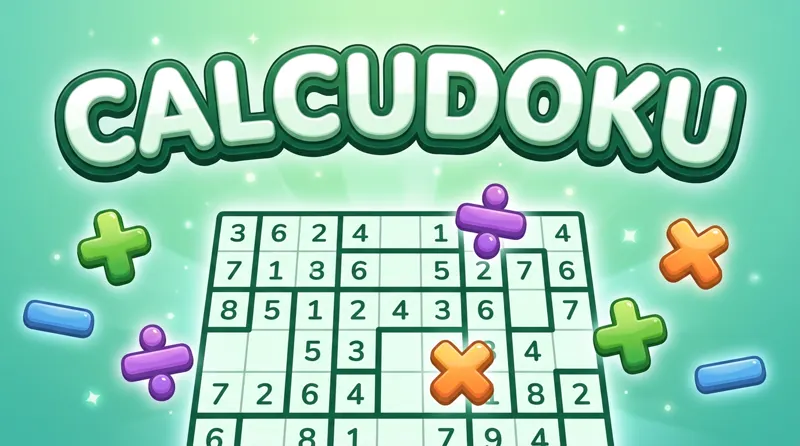
Calcudoku is a number puzzle that mixes sudoku-style rules with simple arithmetic. Every row and column uses each number once, and outlined cages tell you what their numbers must add, subtract, multiply or divide to.
If you enjoy KenKen-style puzzles, this is the same idea, free and unlimited. Start small, and within a few grids the combinations will jump out at you.
Where Calcudoku comes from
Calcudoku was invented in 2004 by Tetsuya Miyamoto, a Japanese math teacher who designed it to help his students think through problems. It is also sold under a trademarked name in many newspapers. The grid is a Latin square: each digit appears once in every row and column. Bold cages each show a target and an operation, such as 12× or 2÷, and the digits in the cage must produce that target.
How to play here
Tap a cell and type a digit, or use the number pad on a phone. Right-click a cell for pencil marks with a mouse, or switch on Mark mode on a phone and tap the cell before entering digits. Grids range from 3×3 for beginners to 9×9.
A step-by-step way to solve
- Fill single-cell cages first. They are given digits.
- Solve the tight cages. On a 6×6 grid, a two-cell 30× cage can only be 5 and 6, and a two-cell 11+ cage can only be 5 and 6 as well.
- Use subtraction and division limits. A two-cell 5− cage on a 6×6 grid must be 1 and 6.
- Use the row total. Each row of an n×n grid adds up to the same total (21 on a 6×6). If you know all but one cage in a row, the rest is fixed.
- Combine with Latin-square logic. Once a digit is placed, it cannot appear again in that row or column, which narrows neighboring cages.
Why play Calcudoku?
It mixes quick arithmetic with pure logic, so it trains both. Small grids are friendly for children, while 9×9 grids are a real challenge. If you like it, try Killer Sudoku or Futoshiki.
How to play Calcudoku
- On an N×N grid, place the numbers 1 to N so that no number repeats in any row or column.
- The grid is split into outlined cages, each with a target number and an operation.
- The numbers in a cage must make the target with that operation, in any order.
- For − and ÷ cages of two cells, subtract or divide the smaller number from the larger.
Calcudoku tips
Fill single-cell cages first
A cage of one cell simply shows its answer. Write it in and remove that number from the rest of its row and column.
Work out small products
A 2-cell × cage of 12 in a 6×6 grid can only be 2 and 6 or 3 and 4. Listing the options early narrows the grid quickly.
Use the row total
Each row adds up to the same total, for example 21 on a 6×6 grid. When most of a row is known, the missing number follows.
Frequently asked questions
Is Calcudoku the same as KenKen?
The rules are the same. KenKen is a registered trademark of Nextoy, LLC; Calcudoku is the generic name for the puzzle. MindedGames is not affiliated with Nextoy.
Do I need to be good at maths?
Only basic arithmetic. The challenge is logic, combining the cage sums with the no-repeat rule.
What size should beginners play?
Start with 4×4 or 5×5 using addition and subtraction, then move up to 6×6 with all four operations.