How to play FreeCell: rules, supermoves and winning strategy

How to play FreeCell: the short answer
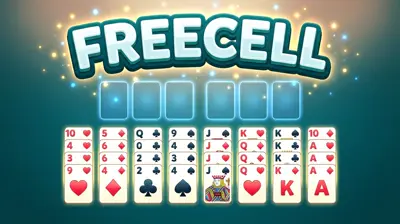
Here is how to play FreeCell: all 52 cards are dealt face up into eight columns. Your goal is to move every card to four foundation piles, one per suit, from Ace up to King. In the columns, you stack cards down in rank and alternating in color, like a red 8 on a black 9. Four free cells in the corner each hold one card while you dig for the ones you need.
Because every card is visible from the start, there is no luck after the deal. It is a planning puzzle with cards, and almost every deal can be won. This guide covers the setup, every legal move, how many cards you can move at once (the supermove rule) and the FreeCell strategy that turns stuck games into wins. Follow along in our free FreeCell game, which deals a new game whenever you like.
The layout: 8 columns, 4 free cells, 4 foundations
FreeCell uses one standard 52-card deck and has three areas.
- Eight columns (the tableau). All 52 cards are dealt face up from left to right, so the first four columns get 7 cards and the last four get 6.
- Four free cells, top left. Each one holds a single card. They start empty.
- Four foundations, top right. Each one builds one suit from Ace to King. They also start empty.
You win when all four foundations reach the King.
The rules for moving cards
Only the bottom card of each column (the one fully in view) can be moved, along with any ordered run on the bottom of a column, as long as you have room for it. These are the legal moves:
- Column to column. A card goes on a card one rank higher and of the opposite color. A black 6 goes on a red 7.
- Into a free cell. Any single card can go into an empty free cell.
- Out of a free cell. A card in a free cell can go to a column, where it must fit the usual rule, or to a foundation.
- To a foundation. An Ace starts a foundation. After that, the next card of the same suit goes on top: 2 on Ace, 3 on 2, and so on.
- Into an empty column. Any card, or any ordered run you have room to move, can go into an empty column. There is no King-only rule as in Klondike.
- Back from a foundation. Our game lets you take the top card of a foundation back down to a column when it fits there.
Ranks run from Ace (low) to King (high), with no wrapping round.
How many cards can you move at once?
Officially, FreeCell lets you move only one card at a time. But if you have space, you could move a run of cards one by one using the free cells and empty columns, then put them back together on the new column. Computer versions do this for you in one move. Players call it a supermove.
The number of cards you can move in one go is:
(empty free cells + 1) × 2^(empty columns)
That is, add one to your empty free cells, then double the result for every empty column.
| Empty free cells | No empty column | 1 empty column | 2 empty columns |
|---|---|---|---|
| 0 | 1 | 2 | 4 |
| 1 | 2 | 4 | 8 |
| 2 | 3 | 6 | 12 |
| 3 | 4 | 8 | 16 |
| 4 | 5 | 10 | 20 |
Our game uses exactly this formula. When you drag or tap a run that is too long for the space you have, it simply will not move.
Why the formula works
With two empty free cells, you can park two cards, move the third to its new place, then bring the two back on top of it. That is three cards, or free cells plus one.
An empty column is better. You can move a whole group of that size into the empty column, move another group of the same size to the target, then move the first group across on top. That doubles what you can move, and a second empty column doubles it again.
Moving into an empty column
When the empty column is where you are moving to, it cannot also be used as a helper. So you count one fewer empty column. With 3 empty free cells and 1 empty column, you can move 8 cards onto another column, but only 4 into the empty column itself.
FreeCell strategy: 8 habits that win
FreeCell rewards planning more than speed. These habits make the biggest difference.
1. Look at the whole deal first
Before your first move, find the four Aces and the 2s. Note which columns bury them deepest. Those are the columns you need to work on.
2. Free the Aces and low cards early
A low card buried under six others blocks everything above it from reaching the foundations. Dig out the Aces, then the 2s and 3s.
3. Keep free cells free
Each card in a free cell lowers the number of cards you can move at once. With all four cells full, you can move one card at a time and are close to stuck. Use a free cell for a move or two, then empty it again.
4. An empty column is worth more than a free cell
The table above shows why. One empty column with no free cells lets you move 2 cards. One empty column with 4 free cells lets you move 10. Getting a column empty early, usually the shortest one, opens up the whole game.
5. Don’t fill an empty column with one card
Putting a single card in an empty column throws away its doubling power. If you must use it, use it for a long run that unlocks something important, or for a high card like a King that you can build on.
6. Build long runs in order
A column that runs cleanly downward in alternating colors is easy to move later. A column with a jumble of mixed cards is hard to clear. When you have a choice, place cards where they extend a clean run.
7. Send cards up when they are safe
A card is safe on the foundations when no lower card of the other color still needs it as a landing spot. Aces and 2s are always safe. With higher cards, check the other color first: a red 5 can go up once both black 4s are already on the foundations, because no card needs it on the table any more.
8. Count before a big move
Before you start a long sequence, count the cards you need to move and compare it with the table. Running out of space halfway is the most common way to get stuck. Use undo freely to test an idea and step back if it fails.
Common FreeCell mistakes
- Filling the free cells early. It feels like progress, but it leaves you with no room in the middle game.
- Ignoring the shortest column. The short columns are the quickest route to an empty column.
- Moving cards to the foundations too soon. A black 7 sent up early may be the only spot for a red 6 you need to move.
- Starting a supermove you cannot finish. Count first.
Is every FreeCell deal winnable?
Almost. When FreeCell came with Windows, it had a numbered set of 32,000 deals, and players worked through them together online. Only one of those deals, number 11982, turned out to have no solution.
The deals in our FreeCell solitaire are random shuffles rather than that numbered set, but the same is true: nearly every one can be won. If you get stuck, the problem is almost always the order of moves, not the cards. Undo a few steps and try another plan.
FreeCell vs Klondike solitaire
| FreeCell | Klondike | |
|---|---|---|
| Cards face up at the start | All 52 | 7 |
| Extra space | 4 free cells | A stock and waste pile |
| Empty columns | Any card or run | Kings only |
| Luck | Almost none after the deal | A lot, from hidden cards |
| Winnable deals | Nearly all | Many deals cannot be won |
If you want the classic version with hidden cards and a deck to draw from, read our guide on how to play solitaire. For another long-planning card game, Spider Solitaire is the next step, and our spider solitaire rules explain it from scratch.
FAQ
What are the rules of FreeCell?
Deal all 52 cards face up into eight columns. Build four foundations by suit from Ace to King. In the columns, stack cards down in alternating colors. Four free cells each hold one card. Any card can go into an empty column.
How many cards can you move at once in FreeCell?
You can move (empty free cells + 1) × 2^(empty columns) cards. With 4 free cells and no empty column, that is 5 cards. With 4 free cells and 1 empty column, it is 10. Moving into an empty column, count that column out.
Can every game of FreeCell be won?
Nearly every deal can. In the famous set of 32,000 Windows deals, only deal 11982 has no solution. If you get stuck, undo and try a different order of moves.
What is the best FreeCell strategy?
Free the Aces and low cards first, keep your free cells empty as much as you can, and aim for an empty column early. Count the cards before every big move.
Is FreeCell harder than regular solitaire?
It is different rather than harder. FreeCell has no hidden cards, so every game is a planning puzzle, and almost every deal can be won. Klondike depends more on the luck of the hidden cards.