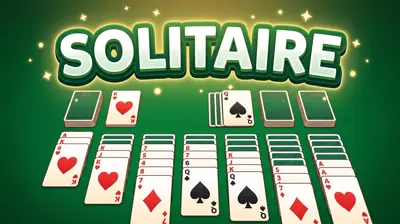
How to play solitaire: Klondike rules, setup and winning tips

How to play solitaire: the short answer
To play solitaire (the classic version is called Klondike), you move all 52 cards onto four foundation piles, one per suit, building each from Ace up to King. On the table, you stack cards in seven columns going down in rank and alternating in color, like a red 6 on a black 7. When you are stuck, you turn cards from the deck. Clear every card to the foundations and you win.
Those are the core solitaire rules. The rest of this guide explains the setup, every legal move, Draw 1 versus Draw 3, how scoring works, and the habits that win more games. You can follow along in our free online solitaire, which deals a new game whenever you want one.
The setup: 28 cards in 7 columns
Klondike uses one standard deck of 52 cards, no jokers.
- Deal seven columns from left to right. The first column gets 1 card, the second 2, the third 3, and so on up to 7 cards in the seventh column. That is 28 cards in total.
- Turn the top card of each column face up. All the cards underneath stay face down.
- Put the remaining 24 cards face down in the top-left corner. This is the deck, also called the stock.
- Leave room for four foundation piles in the top row. They start empty.
The seven columns are called the tableau. The cards you turn from the deck go face up onto a waste pile next to it.
The goal
Build four foundation piles, one for each suit. Each pile starts with an Ace, then goes 2, 3, 4 and up to the King, all in the same suit. When all four piles reach the King, every card is home and the game is won.
The solitaire rules for moving cards
These are all the moves you can make.
- Column to column. A face-up card can go on a card one rank higher and of the opposite color. A red 9 goes on a black 10; a black Jack goes on a red Queen.
- Moving a stack. A run of face-up cards that is already in order (alternating colors, going down) can move as one group, as long as its top card fits where you put it.
- Turning hidden cards. When you move the last face-up card off a column, the face-down card beneath it is turned over and becomes playable.
- Empty columns. Only a King, or a stack that starts with a King, can go into an empty column.
- To the foundations. An Ace can start a foundation at any time. After that, the next card of the same suit goes on top: 2 on Ace, 3 on 2, and so on.
- From the deck. Turn cards from the deck onto the waste pile. Only the top card of the waste pile can be played, onto a column or a foundation.
- Recycling the deck. When the deck is empty, turn the waste pile over to make a new deck. Some rule sets limit how many times you can do this. Our game lets you go through the deck as often as you like.
- Back from a foundation. Most computer versions, ours included, let you move the top card of a foundation back onto a column when you need it.
Ranks go from Ace (low) to King (high). There is no wrapping round: you cannot put a King on an Ace.
Draw 1 vs Draw 3
The only difference between the two common versions is how many cards you turn from the deck at a time.
| Draw 1 | Draw 3 | |
|---|---|---|
| Cards turned from the deck | One at a time | Three at a time |
| Which card you can play | The one you turned | Only the top one of the three |
| Difficulty | Easier, most cards are reachable | Harder, many cards stay buried |
| Best for | Learning and relaxed games | The classic challenge |
In Draw 3, the deck comes round in the same groups of three until you play a card from the waste. Every card you play from the waste shifts all the groups after it by one, which can bring a stuck card to the top next time round. Good Draw 3 players watch the deck closely for exactly this reason. Try it on our Solitaire Turn 3 page, which starts in Draw 3 mode.
How solitaire scoring works
Scoring is optional: the real goal is simply to win. Our version tracks your number of moves and your time, so you can try to beat your own best game.
Many computer versions also use a points system. The standard one works roughly like this:
| Move | Points |
|---|---|
| Card from the waste to a column | +5 |
| Card turned face up in a column | +5 |
| Card moved to a foundation | +10 |
| Card moved from a foundation back to a column | −15 |
Some versions also take points away for time or for recycling the deck. Vegas scoring is a different system: you start by “paying” 52 points (or dollars) and earn 5 for every card you get onto the foundations, usually with a limited number of passes through the deck.
How to win more games of solitaire
Not every deal can be won, and Draw 3 games are lost more often than Draw 1. But careful play wins far more games than fast play. These habits make the biggest difference.
1. Expose face-down cards first
The face-down cards in the columns are what stop you. When you have a choice, prefer the move that turns a hidden card over. A move from the deck can wait; a buried card cannot be reached any other way.
2. Work on the biggest column
The seventh column starts with six hidden cards. Freeing it early opens up more of the game than clearing a short column.
3. Don’t rush cards to the foundations
It feels like progress, but a card on a foundation can no longer hold other cards on the table. A black 5 sitting on the table might be the only place for a red 4 you need to move.
Aces and 2s are the exception: send them up straight away. Nothing can be placed on an Ace in the columns, so a 2 never has a job to do on the table. For higher cards, ask whether you still need them as a landing spot.
4. Empty a column only when a King is ready
An empty column can only take a King. Clearing one with no King to put there can leave you with a useless space. When you do have a choice of Kings, pick the one that matches the next cards you need: if a red Queen is waiting, play a black King.
5. Choose the right card when two can move
If two red 6s could go on your black 7, move the one whose departure turns a hidden card over or empties a column. The other 6 can wait.
6. Go through the deck before committing
Early in the game, it often helps to turn through the whole deck once to see what is in it. Then you know which cards are coming and can plan the column moves around them.
7. Use undo to explore
Our game has unlimited undo. When two moves look equal, try one, see what it opens, and step back if it leads nowhere.
Common beginner mistakes
- Playing from the deck before the table. Check every column move first. Table moves reveal hidden cards; the deck never does.
- Sending every card to the foundations automatically. Keep middle cards on the table while they are still useful.
- Filling an empty column with the wrong King. Look at which Queens are available before you choose.
Other kinds of solitaire
Klondike is the best known, but “solitaire” covers hundreds of one-player card games. These are the ones you can play here for free:
- Spider Solitaire uses two decks and ten columns. You build runs from King down to Ace in one suit, with 1, 2 or 4 suits. Our guide to spider solitaire rules explains it step by step.
- FreeCell deals every card face up and gives you four free cells to park cards. Almost every deal can be won with careful planning.
- Pyramid Solitaire asks you to remove pairs of cards that add up to 13 from a pyramid of 28 cards.
- TriPeaks Solitaire clears three peaks by playing cards one rank higher or lower than the pile.
- Golf Solitaire works the same way with seven columns of five, and you score like golf: the fewer cards left, the better.
If you like classic games with simple rules and a lot of depth, our guide on how to play checkers is another good place to start.
FAQ
What are the basic rules of solitaire?
Build four foundation piles by suit from Ace to King. In the seven columns, stack cards down in alternating colors, and only put a King in an empty column. Turn cards from the deck when you run out of moves.
How many cards do you deal in solitaire?
Klondike deals 28 cards into seven columns: 1 card in the first column, up to 7 in the last, with the top card of each face up. The remaining 24 cards form the deck.
Is every game of solitaire winnable?
No. Some Klondike deals cannot be won however well you play, and Draw 3 games end in a loss more often than Draw 1. Careful play and undo help you win most of the games that can be won.
What is the difference between Draw 1 and Draw 3 solitaire?
In Draw 1 you turn one card from the deck at a time and can play each one. In Draw 3 you turn three and can only play the top one, so cards get stuck deeper in the waste pile. Draw 3 is the classic, harder version.
Can you move a card back from the foundation?
In most computer versions, yes. You can move the top card of a foundation back onto a column if it fits there. Our free solitaire game allows it too, so give it a try.