How to play checkers: the complete beginner's guide
Try it: find the double jump
You are red and move up the board. Tap the red piece that can capture, then tap where it lands. Keep jumping.
Checkers in one minute
Checkers (called draughts in the UK) is a two-player strategy game played on an 8×8 board. Each player has 12 pieces. You move diagonally, you capture by jumping over your opponent’s pieces, and your goal is to leave the other player with no pieces or no legal moves. The rules take five minutes to learn, yet strong players study the game for years.
This guide covers the standard American rules, also known as English draughts. You can practise everything below in our free online checkers game, against the computer at three levels or against a friend on the same screen.
The board and the setup
- The board has 64 squares in alternating light and dark colours. Only the dark squares are used.
- Place the board so each player has a dark square in their bottom-left corner.
- Each player puts their 12 pieces on the dark squares of the three rows closest to them. The two middle rows start empty.
- Traditionally the darker pieces move first; in many online games, including ours, red moves first.
How pieces move
A regular piece, often called a man, moves one square diagonally forward onto an empty dark square. It can never move backwards and never moves sideways or straight ahead.
How to capture
If an opponent’s piece is diagonally next to yours and the square directly beyond it is empty, you can jump over it and land on that empty square. The jumped piece is removed from the board.
- Multi-jumps: if, after a jump, another jump is possible from your new square, you must continue jumping in the same turn. A single move can capture two, three or more pieces.
- Captures are compulsory: in standard rules, if any capture is available, you must take one. If several captures are possible, you may choose which one. This rule is the heart of checkers strategy, because you can force your opponent into jumps that set up your own bigger jumps.
Kings
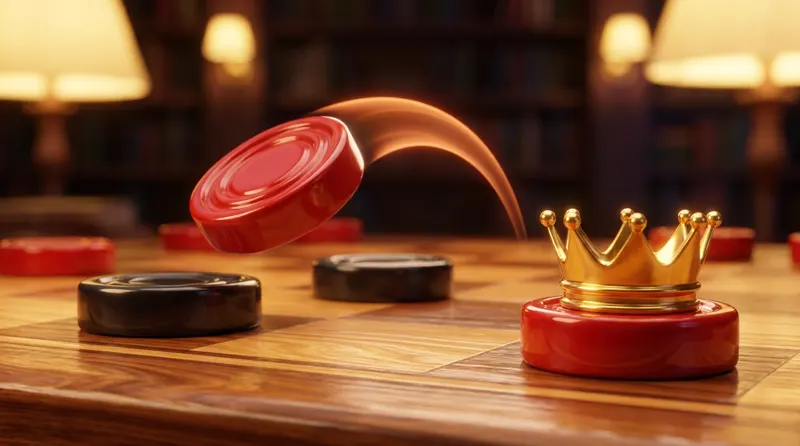
When one of your men reaches the far row of the board, it is crowned and becomes a king. In a real game you stack a second piece on top; online, a crown appears. Kings can move and capture diagonally forwards and backwards, which makes them far more powerful. In American rules, a man that reaches the far row by jumping ends its move there, even if it could jump again as a king.
How to win (and draw)
You win when your opponent has no pieces left, or cannot make any legal move because all their pieces are blocked. A game is a draw when neither side can make progress; many online versions, ours included, call a draw after a long run of moves with no capture.
How to win at checkers: 8 strategy tips
Winning at checkers comes down to three things: keeping more pieces than your opponent, getting kings first, and never walking into a forced jump. These eight tips cover all three, and they work against the computer and against people.
- Control the centre. Pieces in the middle of the board have more moves and support each other. Pieces on the edge are safe but passive.
- Keep your back row as long as you can. Your back row stops your opponent from crowning kings. Many strong players leave two back-row pieces at home for a long time.
- Move in groups. A piece with a friend behind it cannot be jumped from that side. Lonely pieces become targets.
- Use the forced-capture rule. Offer a piece deliberately when the forced jump lands your opponent where you can take two pieces back. This is the most common winning trick in checkers.
- Count before you trade. Trading one for one is good when you are ahead in pieces; it brings you closer to an endgame you can win.
- Race for kings. Once the board opens up, the first player to crown a king often takes control.
- Do not rush to the edge. Edge pieces can only be attacked from one side, but they can also only move one way.
- Think one reply ahead. Before every move, ask: after this, can my opponent jump me?
Finishing the game when you are ahead
Being a piece up is not a win until you turn it into one. The plan is simple: trade down. Every even trade makes your extra piece count for more. Five against four is close; two against one is usually over.
Next, crown your kings before you hunt. A king can chase from behind; a man can only push forward. Then corner what is left. A lone enemy king will run for the double corner, the pair of dark squares in the corner on each player’s right-hand side, because it can shuttle between them. Two kings can drive it out: use one to take away its escape squares and the other to close in, then force it into a trade or a jump.
Last, watch for draws. If you are ahead but keep moving kings back and forth without a plan, the game may end in a draw. Make every move bring a piece closer to the enemy’s last pieces.
Common beginner mistakes
The most common mistake is forgetting that captures are compulsory, and walking into a double jump. The second is moving the back row too early, which opens the road for the opponent’s kings. The third is chasing single pieces across the board with a king while the opponent crowns their own.
Practise now
The fastest way to learn is to play. Start our checkers game on easy, where the computer makes deliberate mistakes, then move to medium and hard as the rules become second nature. If you enjoy strategy games against the computer, Reversi, Four in a Row and Mancala use the same three difficulty levels.