Schulte table: how to use it, and what it can really do
What is a Schulte table?
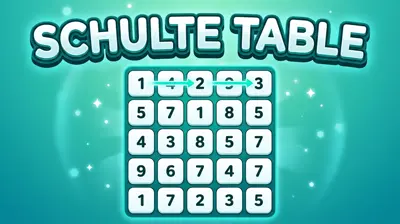
A Schulte table is a square grid, classically 5×5, filled with the numbers 1 to 25 in random order. Your job is to find and tap them in order, 1, 2, 3 and so on, as fast as you can. That is all.
It is named after Walter Schulte, a German psychiatrist who designed it in the mid-20th century as a test for studying attention. Psychologists used it to measure how quickly and steadily a person could search a visual field. A later version by the Soviet psychologist R. M. Gorbov uses two sets of numbers in red and black that you alternate between, which adds a switching challenge.
You can try a Schulte table here, in sizes from 3×3 up to 7×7.
How to use it
- Start with 5×5. It is the classic size and the one most people compare times on. Use 3×3 or 4×4 if you are new or training a child.
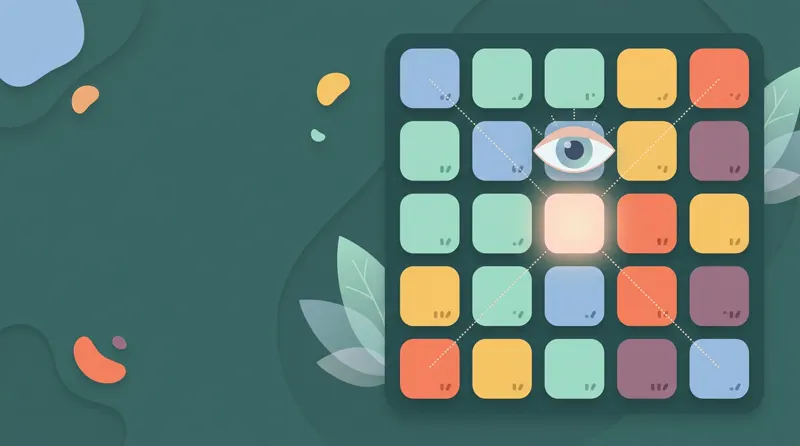
- Keep your eyes near the center. Try to spot numbers without darting your eyes around the whole grid. This is harder than it sounds and is what makes the exercise demanding.
- Do not say the numbers out loud or in your head. Just look and tap.
- Do a few rounds, then stop. Three to five tables is enough. Times get worse once you are tired, and tired practice does not help.
- Track your own times. The only fair comparison is with yourself on the same size, on the same device.
What happens when you practice
Your times will drop, often quickly over the first days. That is real improvement, but it is improvement at this task: you get better at scanning this kind of grid, learning where to look and staying calm under the clock.
That is the same pattern researchers find with almost every brain-training task. People get clearly better at what they practice, and much less at anything else. We covered the best-studied example, dual n-back and IQ, in a separate article.
What the research says
There is surprisingly little research on Schulte tables in English-language science, and almost none on training with them.
- Researchers do use Schulte grids as a measurement tool. For example, a 2022 study in Brain and Behavior recorded the brain activity of 27 schoolchildren while they searched single-color and red-and-black grids, to understand how color and the number of targets affect attention. That was a single session, not a training program.
- We found no well-controlled trials showing that practicing Schulte tables improves attention, concentration or school results outside the grid itself. Many websites quote large percentage improvements, but they rarely say where those numbers come from.
So the honest summary is: a Schulte table is a good test of visual search and focus, and a nice short concentration exercise. There is no good evidence that it transforms your attention in general.
Does it help speed reading?
This is the biggest claim made for Schulte tables, and the one with the least support. The idea is that training your peripheral vision lets you read whole lines, or even pages, at a glance.
A major 2016 review of reading research by Keith Rayner and colleagues looked at exactly this. The problem is biology: we can only read words clearly close to the point we are looking at. Accuracy drops sharply just a few degrees away from that point. Reading faster than normal mostly means understanding less, and the review found no shortcut that avoids this trade-off.
Practicing a number grid does not change how your eyes resolve letters. If you want to read faster, the review’s advice is to read more, grow your vocabulary and skim deliberately when full understanding is not needed.
So is it worth doing?
Yes, as long as you know what you are getting:
- A quick focus warm-up before studying or working.
- A fun challenge with a clear score, especially for kids learning numbers.
- A test of your sharpness today, which can change with sleep, stress and time of day.
Pair it with other short tests, such as the Stroop test for attention control and the reaction time test, and treat all of them as games, not as treatments.
Sources
- Lu, et al. (2022). Attention mechanisms underlying dual-color digital visual search based on Schulte grid: an event-related potential study. Brain and Behavior.
- Rayner, K., Schotter, E. R., Masson, M. E. J., Potter, M. C., & Treiman, R. (2016). So much to read, so little time: how do we read, and can speed reading help? Psychological Science in the Public Interest, 17(1), 4–34.