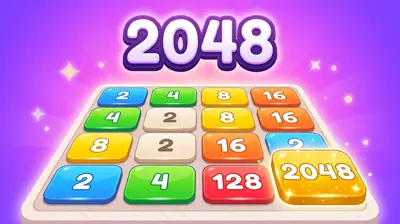
Does the 2048 corner strategy work? We played 10,000 games to find out

The short answer
The corner strategy is good advice, but not the way it is usually explained. Many guides say that if you keep your biggest tile in a corner and mostly swipe in two directions, you will reach 2048 almost every time. We tested exactly that rule in 10,000 games. It did not reach 2048 once. It did not even reach 1024.
What does work is the idea behind the corner strategy, applied with a little thought on every move. A simple computer player that keeps the corner idea but looks just two moves ahead reached 2048 in more than a quarter of its games, and much further when it did not.
Want to try it yourself as you read? Play 2048 here. Our version has undo, so you can test each tip without losing your game.
How we tested
We wrote a small 2048 simulator with the standard rules: a 4×4 board, every move slides and merges tiles, and a new tile appears on a random empty cell after each move (a 2 nine times out of ten, a 4 otherwise). Then we let four players loose on it:
- Random: swipes in a random direction that changes the board.
- Corner rule: always swipes down if it can, otherwise right, otherwise left, and up only when nothing else works. This keeps the big tiles in the bottom-right corner, which is the strategy as most guides describe it.
- Down-right shortcut: alternates down and right, and only uses left or up when stuck. This is the famous “just spam down and right” trick.
- Planning player: keeps the same corner idea, but for every move it looks two moves ahead, including where the new tile might appear, and picks the move that leaves the board in the best shape. “Best shape” means big tiles in the corner, in order along the bottom row, and as many empty cells as possible.
The first three players each played 10,000 games. The planning player is much slower, so it played 300.
The results
| Player | Games | Reached 256 | Reached 512 | Reached 1024 | Reached 2048 | Typical best tile |
|---|---|---|---|---|---|---|
| Random swipes | 10,000 | 7.4% | 0% | 0% | 0% | 128 |
| Corner rule | 10,000 | 51.6% | 4.8% | 0% | 0% | 256 |
| Down-right shortcut | 10,000 | 51.0% | 3.3% | 0% | 0% | 256 |
| Planning player (2 moves ahead) | 300 | 99.7% | 96.7% | 74.7% | 28.7% | 1024 |
“Typical best tile” is the median: half of the games ended with a smaller best tile, half with a bigger one.
Why the corner rule on its own fails
The corner rule is about where your big tile lives, and that part is right. But a game of 2048 is lost in the rows next to the corner, not in the corner itself. Following a fixed order of swipes, the rule:
- Fills the bottom row with mismatched tiles. A 4 lands between a 64 and a 32, and nothing can ever merge past it.
- Runs out of safe moves. When down, right and left are all blocked, the only move left is up, which pulls the big tile out of the corner, and a small tile drops into its place.
- Ignores where the next tile will appear. Half the time the new 2 lands exactly where you least want it.
The down-right shortcut fails for the same reasons. It is a slightly faster way to play the same rule.
What the planning player does differently
The planning player keeps the corner, but on each move it asks: after this swipe and the random new tile, which board looks best? That one question turns into a handful of habits you can use yourself.
1. Keep the edge row in order
Line up the bottom row from big to small, starting at your corner: 256, 128, 64, 32. When the row is in order, one merge can trigger the next, like dominoes. Then continue on the row above, back the other way. This zigzag is often called the “snake”.
2. Keep empty cells
Empty cells are your breathing room. A board with five or six empty cells can survive a bad tile; a board with one empty cell cannot. Before you swipe, count how many cells the move will free.
3. Think about the new tile
After each swipe, a new tile appears on a random empty cell. Prefer moves that leave few empty cells in dangerous places, such as the cell right next to your big corner tile.
4. Never make the “up” move lightly
If up is your only option, first check whether a small merge somewhere else would give you a different move. When you truly must go up, go back down on the very next move so the corner is refilled by the tile you want.
5. Build small tiles near the big ones
Make your new 4s and 8s on the row above the corner row, close to the tile they will eventually merge into. Small tiles far away from the corner are the ones that end up stuck.
Does looking further ahead help even more?
Yes. Our planning player only looked two moves ahead, and it still reached 1024 three times out of four. Programs that search deeper reach 2048 far more often and routinely build tiles well beyond it. The lesson for a human player is the same: you do not need a secret pattern, you need to look one or two moves ahead every time instead of swiping on autopilot.
A simple plan to reach 2048
- Pick a corner (bottom-right is fine) and keep your largest tile there all game.
- Fill the bottom row in order, largest at the corner, then snake back along the row above.
- Before each swipe, picture the board after the move. Prefer moves that keep empty cells and keep the bottom row full.
- Avoid the fourth direction. If you must use it, undo the damage on the next move.
- When the board gets tight, slow down. Most lost games are lost in two or three hasty swipes.
About the study
- Rules: standard 2048, 4×4 board, new tile 2 (90%) or 4 (10%) after every move, game over when no move changes the board.
- Players: random, corner rule (down > right > left > up), down-right alternation, and a planning player (expectimax, two moves deep, scoring big tiles along a zigzag from the corner plus empty cells).
- Games: 10,000 each for the first three players and 300 for the planning player, played on 27 September 2026 with a fixed random seed so the results can be repeated.