Number bonds and ten frames: a parent's guide
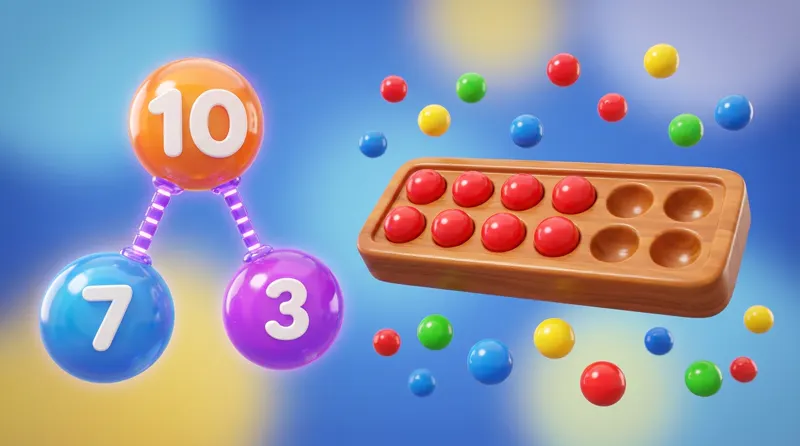
Try it: make ten
Tap the blue counters to move them into the first ten frame. When it is full, you can read the answer: ten and some more.
Why your child’s homework looks different
If your child’s math homework is full of circles joined by lines, or boxes arranged in rows of five, you are looking at number bonds and ten frames. They can look strange if you learned math with columns and carrying, but they are two of the most useful tools in early math, and they are easy to practise at home.
What is a number bond?
A number bond shows how a whole splits into parts. It is usually drawn as three circles: the whole on top, the two parts below.
- 10 splits into 7 and 3.
- 10 splits into 6 and 4.
- 5 splits into 2 and 3.
The same bond gives four facts: 7 + 3 = 10, 3 + 7 = 10, 10 − 3 = 7 and 10 − 7 = 3. That is why teachers love them: children learn addition and subtraction as two sides of one idea. Research shows young children find this link between adding and subtracting hard to discover on their own, so seeing it drawn helps.
Which bonds matter most?
Start with the bonds of 5, then the bonds of 10:
| Bonds of 10 | |
|---|---|
| 1 and 9 | 6 and 4 |
| 2 and 8 | 7 and 3 |
| 3 and 7 | 8 and 2 |
| 4 and 6 | 9 and 1 |
| 5 and 5 | 10 and 0 |
When these are automatic, adding and subtracting within 20 become much easier.
What is a ten frame?
A ten frame is a rectangle of two rows with five boxes each. Counters go in from the top left. Because the rows hold five, children see numbers as groups:
- 7 is a full row and 2 more.
- 9 is one box short of 10.
- The empty boxes show the bond: 7 counters, 3 empty boxes, so 7 and 3 make 10.
Ten frames sit between real objects and written numbers, which matches the concrete, pictorial, abstract order that research recommends for teaching addition and subtraction.
How bonds and frames work together: make ten
The payoff comes when children add past 10. For 8 + 5, use two ten frames: 8 counters in the first, 5 in the second. Move 2 counters to fill the first frame. Now there is a full ten and 3 more: 13. Children who know that 8 and 2 make 10 can do this in their heads. Our step-by-step guide on how to teach a child addition shows where this fits.
Five games to play at home
- Fingers down. Hold up 6 fingers. How many are down? That is the bond of 10.
- Egg carton frame. Cut two cups off a 12-egg carton to make a ten frame. Fill it with pasta and ask how many more make 10.
- Hide and count. Put 10 grapes on a plate, hide some under a cup, and ask how many are hidden.
- Bond snap. Write 0 to 10 on cards. Turn two over; if they make 10, shout “bond!”
- Online practice. The number bonds game and the ten frame game practise exactly these ideas in ten-question levels, with a tip after every mistake.
Number bonds beyond 10
Once the bonds of 10 are secure, the same idea grows with your child. The bonds of 20 follow the same pattern (13 and 7, 15 and 5), and later the bonds of 100 use tens (60 and 40, 70 and 30). Children who learned the bonds of 10 with pictures usually find these larger bonds easy, because they recognise the pattern.
How long should my child practise?
A few minutes a day is enough. Short, regular practice helps facts move into long-term memory better than one long session, and it keeps math light and fun.
Common questions
My child counts the counters one by one. Is that wrong? No, it is a normal stage. Ask them to find the full row of five first, and they will start using it.
Should my child still use fingers? Yes. Fingers are a ten frame they always carry. Over time the bonds become known facts and fingers are needed less.
What comes next? Adding and subtracting within 20 with make ten and think addition, practised in addition games and subtraction games.