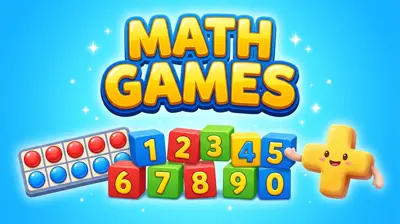
What a ten frame teaches
A ten frame is one of the simplest and most useful tools in early math: two rows of five boxes. Put counters in it and a number stops being a word and becomes a shape. Seven is a full row and two more. Nine is one box short of ten. Children who see numbers this way start to reason instead of counting from one every time.
This free ten frame game practises three ideas in order.
Step 1: how many?
Counters appear in the frame and your child taps how many. On level 1 the numbers stay at 5 or fewer. On level 2 they go up to 10, and the tip explains the trick: “the top row is 5, seven is 5 and 2 more”. On level 3 the frame shows only for a moment, so your child learns to recognise the shape of each number.
Step 2: how many more make 10?
Now the frame shows, for example, six counters and four empty boxes. The question asks: six and how many make ten? Children count the empty boxes, and the pairs that make 10 (6 and 4, 7 and 3, 8 and 2) slowly become known facts. Level 1 practises pairs that make 5 in a five-box frame; level 3 asks without the picture. These pairs are called number bonds, and they are the most important facts in early addition.
Step 3: add to 5
Red and blue counters share the frame: two red and three blue. How many altogether? This is adding in its most concrete form. The next steps, in addition games, move on to counting on and making ten.
Why ten frames work
Early math research recommends moving from real objects to pictures to symbols, and ten frames sit exactly in the middle: they are pictures that behave like objects. Grouping by five and ten also prepares children for place value, where ten ones become one ten. Teachers use ten frames every day in kindergarten and first grade, and this game lets children practise the same model at home.
Friendly by design
One question at a time, big buttons, no timer, and a tip after every mistake. Ten questions make a level, and each level earns up to three stars. Progress is saved on your device, and the complete path from counting to subtraction within 20 is in Math Games for Kids.
A ten frame at home
Draw two rows of five boxes on paper, or use an egg carton with two cups cut off. Build numbers with buttons, pasta or coins, and ask how many more make ten. Five minutes like this, a few times a week, gives children a picture of numbers they will use for years.
How to play Ten Frame Game
- A ten frame has two rows of five boxes. Counters fill the boxes from the top left.
- Step Ten frame asks how many counters you see. Level 3 shows the frame only for a moment.
- Step Number bonds shows some counters and asks how many more make 5 or 10. Count the empty boxes.
- Step Add to 5 shows red and blue counters. How many altogether?
Ten Frame Game tips
Look at the rows
A full top row is 5. Seven is a full row and two more. Children who learn to see the five stop counting one by one.
Empty boxes matter
The empty boxes show how many more make 10. That idea, called a number bond, is the key to adding past 10 later.
Make a paper ten frame
Draw two rows of five boxes on paper and use buttons or coins. Build a number, then check it in the game.
Frequently asked questions
What is a ten frame?
A ten frame is a rectangle of two rows with five boxes each. Counters placed in it show a number as a group of five and some more, which helps children see amounts and learn the facts that make 10.
When do children use ten frames?
Mostly in kindergarten and first grade, when children learn numbers to 10 and 20 and start adding and subtracting.
What comes after the ten frame?
Number bonds and adding, then the make-ten strategy for sums to 20, which uses two ten frames.