Play math bingo online free
Math Bingo is classic bingo with a brain twist. Every ball shows a sum, and you mark the answer on your card. Finish the pattern at the top and call BINGO before the robots do. It works on phones, tablets and computers, with no download, no sign-up and no money.
It is a calm way to practise number facts. There is no timer, so you are never rushed, but every answer has to be found while it is still open. That keeps you counting, adding and multiplying all game long.
How Math Bingo works
Your card is a 5 by 5 grid of answers with a free square in the middle. The answers are sorted from the smallest at the top left to the largest at the bottom right, which helps you find a number quickly.
Tap the ball to draw the next sum. Work out the answer. If it is on your card, tap that square to stamp it. You can mark an answer while it is the newest sum or the one just before, which keeps a gold ring. After that it is gone.
Choose your pattern before you start: a line, four corners, an X, the frame or the full card. The small picture at the top always shows it. When your stamps make the pattern, tap BINGO.
Addition, subtraction and multiplication bingo
Pick the kind of sums you want to practise:
- Addition bingo: on the kids level you add a number up to 10, with answers up to 45. On the grown-up level both numbers have two digits, with answers from 20 to 120.
- Subtraction bingo: on the kids level you take away a number up to 10, with answers from 1 to 45. On the grown-up level you take away a two-digit number, with answers from 10 to 99.
- Multiplication bingo: the times tables up to 10 × 10 for kids and up to 12 × 12 for grown-ups. Every product appears once in the bag.
- Mix: all three kinds of sum in one game.
Kids and grown-up levels
The kids level is built for children who are learning addition facts and the first times tables. Its answers come from a small range, so many of them are on your card, and you mark something on most balls. The grown-up level spreads the answers wider, so the card fills more slowly and every sum has to be solved before you know if it counts.
Racing the robots
You play against one, two or three robots, each with as many cards as you. The robots know every answer at once and never miss a number. You are not racing their speed, though. You can take as long as you need on every sum. What matters is that you never let an answer slip past, and that you call BINGO as soon as your card matches. A robot calls its bingo when you draw the next sum, so always check your card first.
Wrong taps are forgiven once per sum. A second wrong tap on the same sum rests your card under a lock until the next ball, so guessing never pays. Calling BINGO too early costs you the next sum.
Why bingo is good maths practice
Number facts become automatic through repetition, and repetition is more fun as a game. Each Math Bingo game asks for dozens of quick sums. A wrong guess costs you, so there is a reason to be careful as well as quick. Because the answers on the card are sorted, children also practise comparing numbers and estimating their size.
Classroom and family use
Math Bingo works well on a big screen as a team game. The class or the family works out each sum together, someone taps the answer, and everyone races the robots as one team. Taking turns at tapping keeps every child involved, and saying each sum aloud helps the facts stick. For a room where everyone has their own paper card, use the Caller on Bingo, which calls classic numbers and shows a board of every number called.
More number games
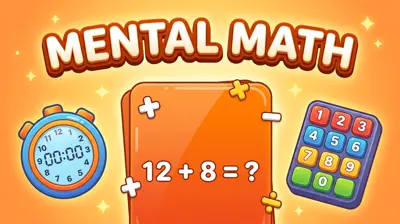
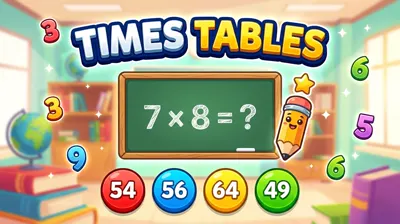
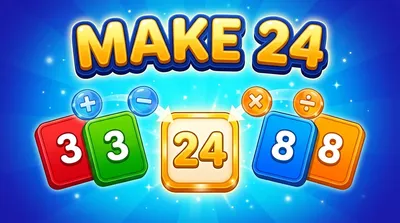
If your child enjoys Math Bingo, try Mental Math for quick sums, Times Tables for focused multiplication practice or Make 24 for a puzzle with four numbers.
How to play Math Bingo
- Tap the ball. Instead of a number it shows a sum, such as 7 + 5.
- Work out the answer and tap it on your card, while it is the newest sum or the one before.
- Finish the pattern shown at the top, then tap BINGO.
- The robots mark their own cards at once. If a robot finishes first and you have not called BINGO, it wins when you draw the next sum.
- A second wrong tap on the same sum rests your card until the next one. Calling BINGO too early costs you the next sum.
Math Bingo tips
Estimate first, then look
The answers on your card are sorted from smallest at the top left to largest at the bottom right. Before you work out the exact answer, guess its size. For 38 + 47 you know it is in the eighties, so look along the bottom rows first.
Make tens
For sums like 8 + 7, move one from the 7 to make 10, then add the rest, so 10 + 5 = 15. For take-aways like 43 − 8, step back to 40 first, then take the last 5 away to reach 35.
Learn the tricky products
Most of the times tables are easy, but 6 × 7, 7 × 8, 6 × 8 and 8 × 9 trip up most players. Say them aloud as they come, 42, 56, 48 and 72. Bingo is a fun way to repeat them until they stick.
Not every answer is on your card
Your card holds 24 answers, and the bag holds many more. When an answer is not on your card, draw again. You can only lose a number you had and did not mark.
Frequently asked questions
What is math bingo?
Math bingo is bingo where the caller reads out a sum instead of a number. Players work out the answer and mark it on their card. The first to finish the pattern calls BINGO. Teachers use it to practise number facts, because every call is a small sum to solve.
Which sums are in the game?
Choose addition, subtraction, multiplication or a mix of all three. On the kids level, sums stay small. You add a number up to 10 to another number, take away a number up to 10, or multiply within the 10 times table. On the grown-up level you add and subtract two-digit numbers and multiply up to 12 by 12.
Is there a timer?
No. You draw each sum when you are ready, and there is no clock. The challenge is to find the right answer and not to miss one, because an answer can only be marked while it is the newest sum or the one before.
What age is math bingo for?
The kids level suits children from about six or seven who know their number bonds and are learning their tables. The grown-up level with two-digit sums and the 12 times table is a good daily warm-up for teenagers and adults.
Can I use it in class or at home with several players?
Yes, as a team game. Put the game on a big screen, let the class or the family work out each sum together, and let one player tap the answer. The whole room then races the robots as one team. For a hall full of paper cards, the Caller on the main Bingo page calls plain numbers instead.
Why did I lose a square?
Each answer can be marked while its sum is the newest or the one before. After that it is gone, and a dashed ring shows the square. Calling BINGO too early also skips one sum for you. On the frame and the full card you can still mark a gone answer late, but the robots get free sums for it, one for the first late mark, two for the second, and so on. On the other patterns, if a lost square blocks every way to finish, the game tells you at once.